
The Weight Permanence Training™: How to Stop Regaining Weight
By Oscar Poon · May 19, 2026
Most people do not struggle to lose weight temporarily. They struggle to stop regaining it.
This is one of the biggest problems in modern weight loss.
Millions of people repeatedly cycle through:
- dieting
- temporary progress
- exhaustion
- regain
- restarting again
The problem is not usually intelligence. Most people already know:
- vegetables are healthier
- processed foods are easier to overeat
- excessive sugar can create problems
- movement matters
- consistency matters
Yet regain still happens repeatedly. Why?
Because temporary motivation eventually loses against automatic behaviour.
The Weight Permanence Training™ (WPT) was created to explain this problem. The framework focuses on helping people:
- understand their psychological state
- identify what is blocking consistency
- develop both PUSH and PULL motivation
- build repeatable actions
- create long term behavioural permanence
The goal is not temporary dieting. The goal is stopping the cycle of constantly regaining weight.
Why Most People Regain Weight
Many weight loss systems focus heavily on:
- calorie restriction
- meal plans
- exercise intensity
- short term discipline
- rapid results
Some people temporarily succeed with these approaches. But eventually:
- life becomes stressful
- routines collapse
- emotional eating returns
- convenience eating returns
- cravings increase
- motivation fades
Then the regain starts again.
This is why the question “How do I lose weight?” is often incomplete. The more important question is: “How do I stop regaining it?”
This is the core problem WPT was designed to address. For the deeper psychology behind the regain cycle, read Why People Regain Weight After Dieting.
What Is the Weight Permanence Training™?
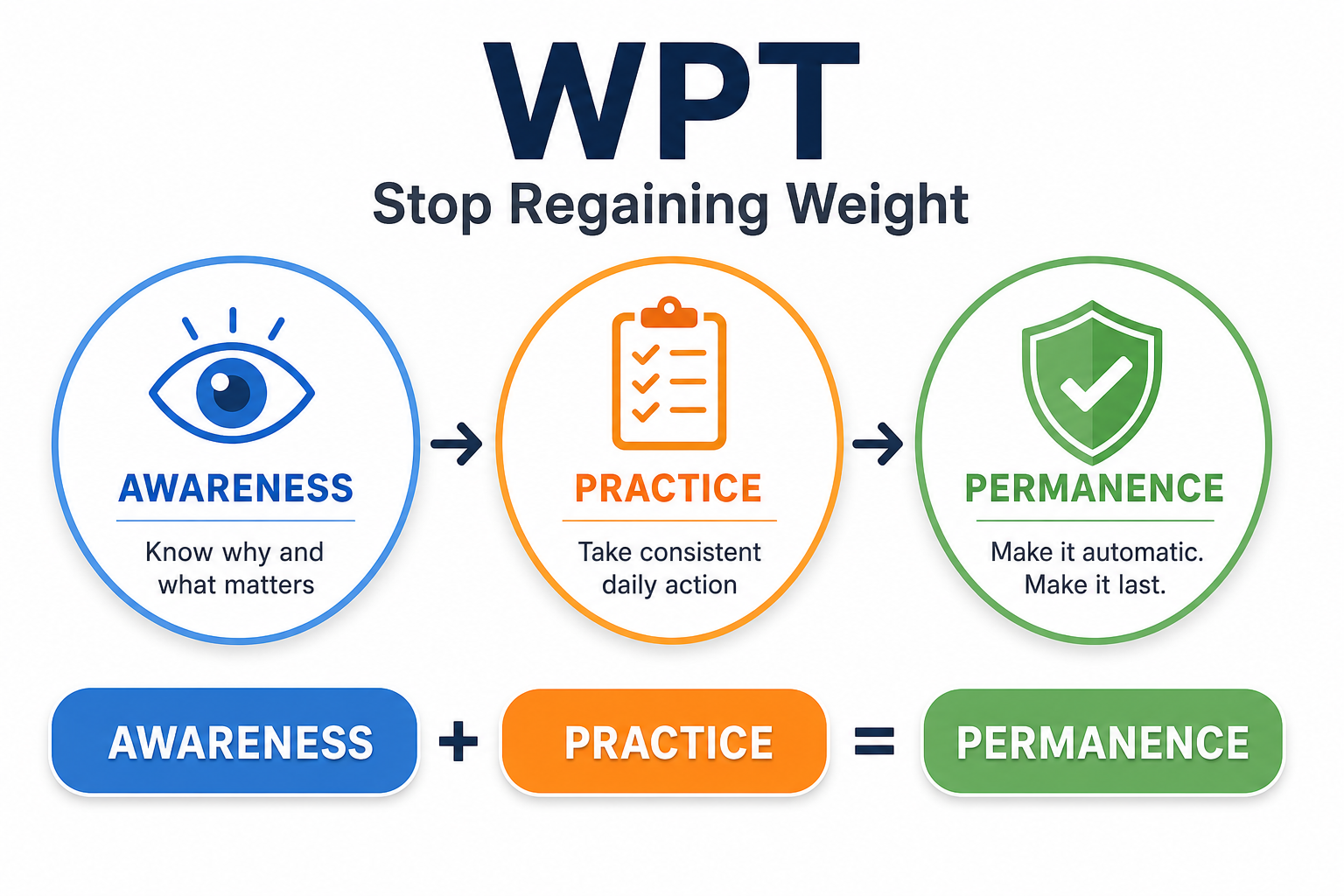
The Weight Permanence Training™ is a behavioural framework designed to help weight loss become psychologically sustainable. The framework has three connected systems:
- Awareness
- Action Practice
- Permanence
Each part supports the others:
- Without awareness, behaviour remains automatic.
- Without action practice, awareness never becomes behavioural change.
- Without permanence, temporary progress collapses once motivation fades.
Together, these systems help create sustainable long term consistency.
Part 1: Awareness
Awareness is the foundation of WPT. Many people try to change behaviour before understanding behaviour. That usually fails.
Awareness helps people recognize:
- why they eat
- when they overeat
- what triggers cravings
- how environments influence decisions
- why previous diets failed
- what psychological patterns repeat
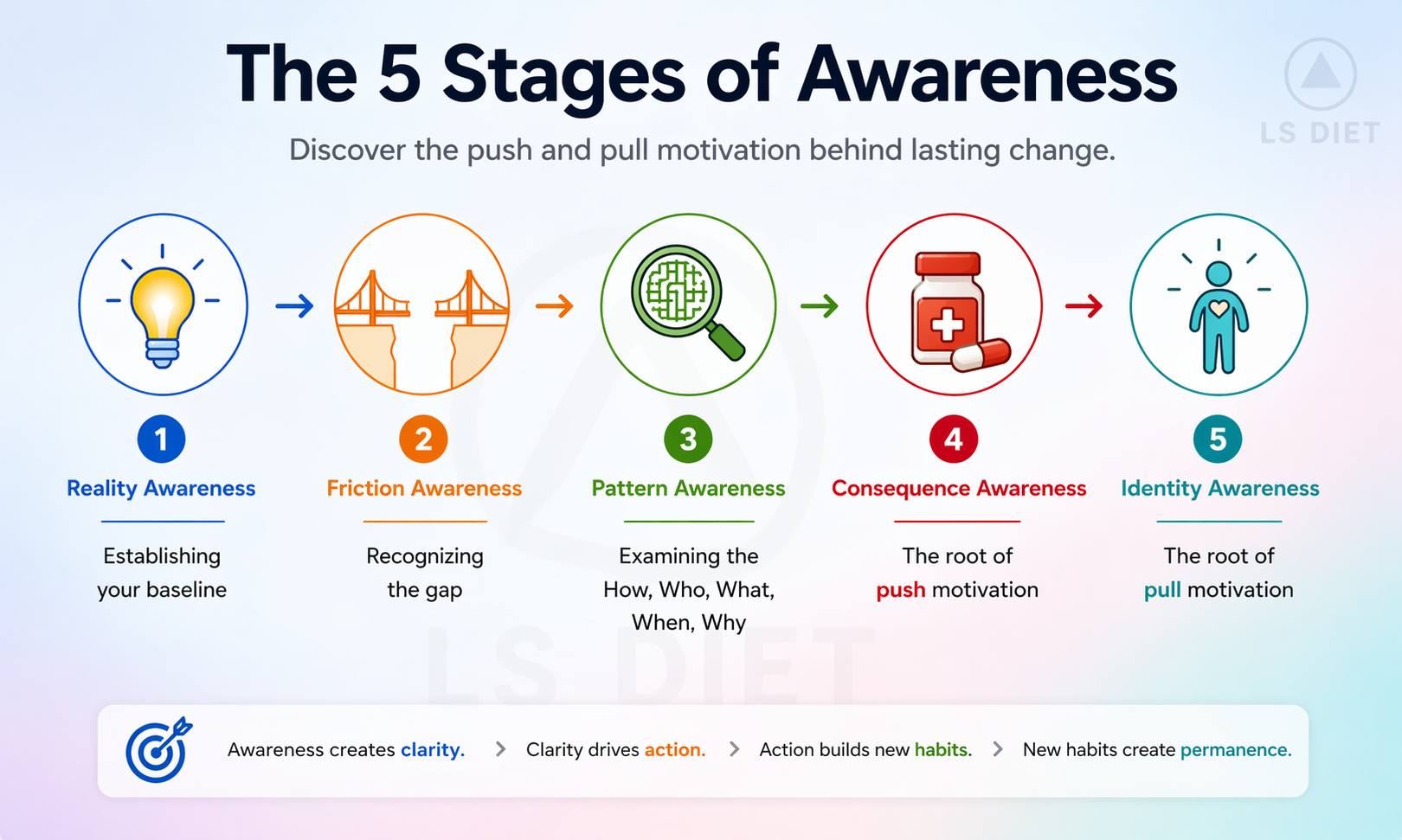
The awareness system has five stages.
Reality Awareness
Reality Awareness focuses on honestly understanding your current situation. Many people underestimate:
- calorie intake
- snacking frequency
- emotional eating
- processed food exposure
- weight regain patterns
Without a clear baseline, weight loss becomes emotional instead of measurable. Reality awareness removes guesswork.
Friction Awareness
Friction Awareness identifies what feels limiting, frustrating, or unsustainable. Examples include:
- low energy
- poor mobility
- emotional discomfort
- social limitations
- lack of confidence
- frustration from repeated regain
This stage helps people recognize the real cost of staying the same.
Pattern Awareness
Repeated behaviour creates predictable outcomes. Pattern Awareness helps identify:
- stress eating
- boredom snacking
- late night eating
- social overeating
- convenience food habits
- emotional eating loops
Most regain patterns are repetitive. Awareness helps expose those automatic cycles.
Consequence Awareness
Consequence Awareness develops PUSH motivation. This stage asks:
- What happens if nothing changes?
- What is repeated regain costing you?
- What future limitations are developing?
The purpose is not fear. The purpose is clarity. Many people avoid thinking long term because it feels uncomfortable. But avoiding reality usually strengthens complacency.
Identity Awareness
Identity Awareness develops PULL motivation. This stage focuses on:
- who you want to become
- what your future could look like
- what weight loss would emotionally mean
- what kind of person you want to be
Weight loss becomes more sustainable when behaviour connects to identity instead of temporary emotion.
Part 2: Action Practice
Awareness alone is not enough. People must repeatedly practice behaviours until they become easier and more automatic. Action Practice turns awareness into behaviour.
This includes:
- low-starch low-sugar meal building
- reducing decision friction
- restructuring food environments
- emotional eating awareness
- movement routines
- simplifying food choices
- tracking behaviours
- interrupting automatic patterns
The goal is not perfection. The goal is repeatability. Small sustainable actions usually outperform aggressive temporary intensity.
Why Small Daily Actions Matter
Many people fail because they rely on emotional intensity. Examples:
- “starting Monday”
- extreme restrictions
- all-or-nothing thinking
- short bursts of motivation
These approaches are difficult to sustain. Action Practice focuses on reducing behavioural resistance instead.
Examples may include:
- walking after waking up
- simplifying meals
- reducing processed food exposure
- stopping at fullness
- improving food awareness
- creating repeatable meal patterns
Practice creates familiarity. Familiarity reduces resistance. Reduced resistance increases consistency.
Part 3: Permanence
Permanence is the long term behavioural anchor. Most people can temporarily force themselves into behaviour. Very few psychologically prioritize those behaviours permanently.
Permanence focuses on:
- consistency
- recovery after setbacks
- emotional resilience
- behavioural anchoring
- sustainable routines
- identity reinforcement
This is where weight loss stops feeling temporary. Instead of constantly negotiating internally every day, healthier behaviour gradually becomes more automatic.
This is one reason LS Diet focuses heavily on:
- sustainability
- simplicity
- reduced friction
- behavioural consistency
- long term lifestyle adoption
The goal is not temporary dieting. The goal is permanence.
Why LS Diet Aligns With the Weight Permanence Training™
LS Diet is designed around sustainability. Instead of aggressive restriction, the system focuses on:
- reducing excessive starch and sugar
- reducing cravings
- improving fullness
- simplifying decisions
- reducing behavioural friction
- creating repeatable routines
- sustainable movement
- awareness based eating
The Weight Permanence Training™ explains the behavioural side behind that lifestyle. Together, they help explain:
- why motivation fades
- why diets collapse
- why emotional eating returns
- why stress disrupts routines
- why people repeatedly restart
- why permanence matters more than intensity
How Does LS Diet Help People Stop Regaining Weight?
Many people already know basic nutrition advice. The difficult part is maintaining consistency when:
- motivation disappears
- stress increases
- emotional eating returns
- life becomes busy
- routines collapse
LS Diet focuses heavily on solving those long term behavioural problems. The system combines:
- low-starch low-sugar eating
- awareness training
- action practice
- repeatable routines
- sustainable movement
- psychological permanence
The goal is not temporary dieting. The goal is to stop repeated weight regain.
Built by Oscar Poon, who lost 80+ lbs three times before designing the system. Explore the Stop Weight Regain topic hub for related foundations.
Stop regaining weight: join the LS Diet community.
Frequently Asked Questions
What is the Weight Permanence Training™?
The Weight Permanence Training™ is a behavioural framework focused on awareness, action practice, and permanence to help reduce repeated weight regain.
Why do most people regain weight after dieting?
Many people rely on temporary motivation and restrictive dieting without developing sustainable behavioural systems or psychological permanence.
What are the 5 Awareness Stages?
The 5 Awareness Stages are: Reality Awareness, Friction Awareness, Pattern Awareness, Consequence Awareness, and Identity Awareness.
What is PUSH and PULL motivation?
Consequence Awareness develops PUSH motivation by understanding the cost of inaction. Identity Awareness develops PULL motivation by connecting behaviour to a desired future identity.
Why is permanence important in weight loss?
Permanence helps behaviours remain consistent during stress, setbacks, and emotional difficulties, rather than collapsing once motivation fades.
How does LS Diet use the Weight Permanence Training™?
LS Diet applies the framework through low-starch, low-sugar eating, behavioural awareness, repeatable routines, and long-term consistency strategies designed to reduce repeated regain.